

Operationalizing High-Risk Retail AI:
From Prohibited Practice to Compliant Customer Intelligence
Overview
Mid sized European retailers are under increasing pressure to leverage AI-driven customer analytics and loss prevention while navigating a rapidly tightening regulatory environment. As the EU AI Act's prohibited practices came into force in early 2025, many firms discovered that their deployed systems, particularly those relying on biometric identification and emotion recognition, fell squarely within prohibited and high-risk classifications. The modern retail landscape now demands a fundamental shift in how firms architect their customer intelligence platforms: from black-box biometric profiling to privacy-preserving, defensible analytics that maintain competitive personalization without regulatory exposure.
The Challenge
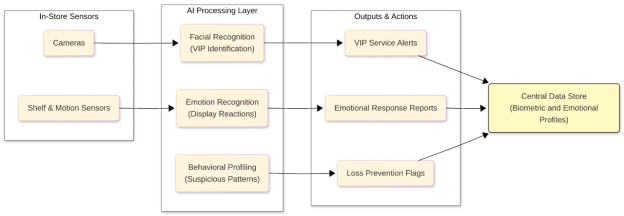
A prominent European luxury retailer had deployed an advanced "Customer Intelligence Platform" across 47 stores. The system used computer vision to:
- Identify returning VIP customers via facial recognition to trigger personalized service alerts
- Analyze emotional responses to window displays and in-store experiences
- Flag "suspicious behavioral patterns" for loss prevention teams
When the EU AI Act's prohibited practices took effect in February 2025, the legal team realized their core infrastructure violated Article 5 (biometric categorization for sensitive characteristics and emotion recognition in public spaces) and Article 6 (high-risk classification for remote biometric identification).
Structural Inefficiencies and Critical Gaps
Upon analysis, the retailer's existing AI infrastructure suffered from three systemic failures that created immediate legal and operational exposure:
1. Prohibited Biometric Identification
The facial recognition system used to identify VIP customers constituted remote biometric identification in publicly accessible spaces, a practice explicitly prohibited under Article 5 of the EU AI Act. The system stored biometric and emotional profiles in a central data store, compounding the GDPR exposure. This single capability placed the entire platform in a prohibited category, requiring immediate decommission or fundamental redesign.
2. Prohibited Emotion Recognition
The system's emotion inference engine used to measure customer reactions to in-store displays fell directly under Article 5's prohibition on emotion recognition systems in public spaces. The firm had no mechanism to distinguish between voluntary engagement signals and inferred emotional states, meaning the entire display-reaction analytics pipeline was non-compliant by design.
3. The Defensibility Gap
The behavioral profiling system flagging "suspicious patterns" for loss prevention lacked any human oversight mechanism or audit trail. Automated flags routed directly to staff actions without documented human review. In a high-risk classification context, the inability to demonstrate human in the loop controls and decision rationale left the firm critically exposed to regulatory challenge and potential sanctions.
Immediate Risks
- Regulatory: Potential fines up to €35M or 7% of global annual turnover
- Operational: Immediate halt to AI-driven customer programs across all EU markets
- Reputational: Consumer backlash against "surveillance retail" amid growing privacy concerns
- Strategic: Blocked expansion into Germany and France where biometric regulations are strictest
The Economic and Procedural Reality
The compliance team faced an impossible choice shut down systems that drove 23% of their personalized revenue, or continue operating in legal gray zones with rapidly escalating liability. The AI driven personalization capabilities were deeply embedded across 47 store locations, meaning a cold shutdown would not only eliminate a significant revenue stream but also disrupt core operational workflows that staff had been trained on for years.
The Q2 2025 enforcement deadline created a hard operational window. With no compliant replacement architecture in place and no documented path to reengineering the platform, the firm risked both financial penalties and permanent exclusion from key European expansion markets, a strategic blow that would undermine the firm's long-term European growth plan.
The Opportunity
Modern retail AI governance requires a shift from reactive compliance to proactive architectural redesign. By re-engineering the platform to achieve the same business outcomes through compliant means replacing biometric identification with behavioral pattern recognition, emotion inference with voluntary engagement metrics, and automated alerts with human-in-the-loop decision support, firms can maintain competitive personalization capabilities while eliminating regulatory exposure entirely.
This presents an opportunity to embed compliance controls directly into the MLOps pipeline, automate documentation generation for ongoing regulatory readiness, and establish a defensible governance framework that enables rather than restricts European market expansion.