
Defensible AI Augmented e Discovery for Mid Sized Litigation Boutique
Overview
Mid sized litigation boutiques are under increasing pressure to compete with global law firms on massive data heavy cases without the benefit of unlimited associate pools. As document volumes in antitrust and multi district litigation soar into the millions, traditional manual review workflows have become a liability. The modern legal landscape requires a fundamental shift in how firms manage discovery. Outdated Technology Assisted Review (TAR) workflows are proving to be economically unsustainable and a significant risk to court defensibility, often leading to budget overruns that can threaten the financial stability of a mid sized firm.
The Challenge
A prominent litigation boutique faced an existential challenge when appointed as co counsel on a high profile antitrust matter. The case involved allegations of price fixing across a major industry consortium, resulting in a staggering 12.4 million documents requiring review. The court imposed a strict 90 day production deadline, creating a timeline that was physically impossible to meet using traditional methods. The firm was forced to choose between declining a career defining case or risking financial catastrophe due to the projected labor costs.
Structural Inefficiencies and Critical Gaps
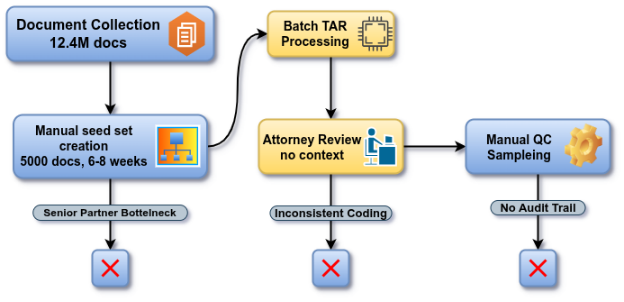
Upon analysis, Sterling’s existing e discovery infrastructure suffered from three systemic failures that made the project economically impossible:
- The Seed Coding Bottleneck: Traditional TAR 1.0 protocols required senior partners to manually code thousands of seed documents to train the algorithm. This process typically consumes six to eight weeks of high value attorney time before any efficiency gains are realized, a luxury the 90 day deadline did not allow.
- The Context Vacuum: Document reviewers were forced to analyze individual files in isolation. Without immediate access to custodian profiles, department structures, or communication networks, attorneys spent nearly a quarter of their time searching for context. This led to high inconsistency in coding and a significant rate of rework during quality control.
- The Defensibility Gap: The firm lacked a robust system for documenting reviewer rationale. In a high profile antitrust case, the inability to prove why a document was marked as privileged or irrelevant leaves the firm vulnerable to court challenges, sanctions, and the forced disclosure of sensitive materials.
The Economic and Procedural Reality
Under traditional linear review, the firm estimated 248,000 attorney hours. The projected cost was nearly double the entire case budget. Furthermore, the lack of continuous active learning meant the firm could not prioritize the most relevant documents early in the process. This created a scenario where the most critical evidence might not be uncovered until the final days of the production window, leaving zero time for case strategy or deposition preparation. The boutique needed a way to transform their capability to survive the deadline and remain profitable.
The Opportunity
Modern litigation requires a shift from batch and review to Continuous Active Learning (CAL). By integrating generative AI directly into the discovery environment, firms can move from manual document tagging to an augmented workflow where the algorithm ranks relevance in real time. This presents an opportunity to reduce senior attorney burden, improve privilege detection precision, and create immutable audit trails that can withstand the highest levels of judicial scrutiny.