
Defensible AI-Augmented e-Discovery for a Mid-Sized Litigation Boutique
TL;DR
A mid-sized litigation boutique faced an existential challenge: a 12.4 million document antitrust case with a 90 day deadline. Traditional Technology Assisted Review (TAR) workflows required 6-8 weeks of senior attorney seed coding before efficiency gains materialized, making the case economically impossible. Their existing infrastructure lacked continuous active learning, contextual document enrichment, and defensible audit trails required by modern e-discovery standards.
DataMills engineered a 90 day integration sprint that deployed AI augmented Continuous Active Learning (CAL) directly into Relativity, built "Smart Context Pipes" for document enrichment, and implemented immutable "Decision Tracers" for defensibility. The solution reduced document review time by 65%, cut senior attorney review burden by 80%, and achieved 94% precision on privilege detection.
The Problem
The boutique firm was engaged as co-counsel on a high profile antitrust matter involving allegations of price-fixing across a major industry consortium. The case presented:
- 12.4 million documents requiring review
- 90-day production deadline
- Privilege protection across 47 custodians
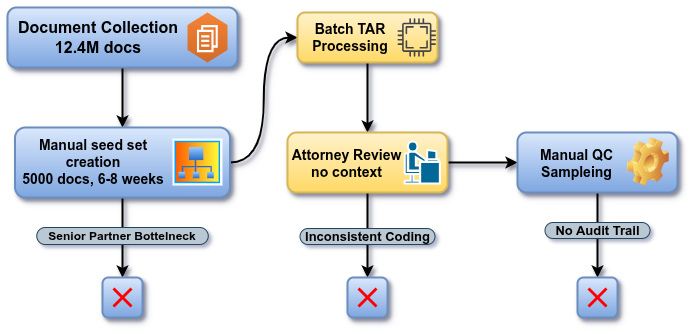
Under traditional linear review, the firm estimated 18,000 attorney hours at $250/hour, totaling $4.5 million nearly double the entire case budget. Their "pre-integration" e discovery infrastructure suffered from three critical gaps:
- No Continuous Active Learning: Traditional TAR 1.0 required 5,000+ seed document reviews (6-8 weeks of senior attorney time) before the algorithm could begin prioritization.
- Context Vacuum: Attorneys reviewed documents in isolation, lacking custodian profiles and communication networks.
- Defensibility Gap: Existing workflows produced minimal documentation of reviewer rationale, leaving the firm vulnerable to court challenges or sanctions.
Approach
DataMills audited Sterling's e discovery infrastructure against court defensibility requirements and mapped operational gaps against the Sedona Conference TAR framework. Instead of treating efficiency as a documentation exercise, the team redesigned the system so AI augmented controls would operate continuously at runtime.
Workflow Autopsy:DataMills engineers shadowed document review sessions for 8 hour shifts, mapping 17 specific breakpoints where the workflow snapped under operational reality. Key findings: attorneys spent 23% of review time navigating between documents and case materials; privilege calls were inconsistent due to lack of custodian context; QC sampling failed to catch systematic coding errors.
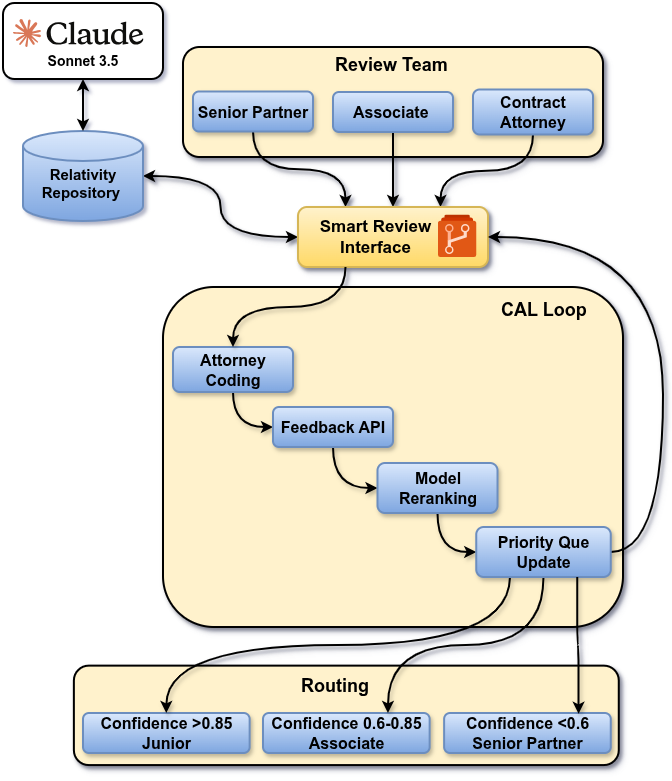
CAL Integration Strategy:Rather than bolting AI onto existing batch workflows, DataMills integrated Anthropic's Claude 3.5 Sonnet directly into Relativity through FastAPI middleware, replacing the "seed then batch" model with Continuous Active Learning where the algorithm begins ranking documents immediately and refines predictions in real-time as attorneys review.
Defensibility-First Design:Every architectural decision prioritized court defensibility: immutable audit trails capturing reviewer identity, time spent, confidence ratings, and rationale; statistical validation with precision/recall tracking; automated performance alerts if metrics degraded below court-accepted thresholds (95%+ relevance, 98%+ privilege).
Solution Delivered
DataMills redesigned Sterling's e discovery infrastructure into a compliance-centric AI system, embedding governance controls directly into runtime operations rather than layering them on afterward.
Continuous Active Learning Engine:Claude 3.5 Sonnet analyzed the 12.4M document corpus to create initial relevance scores without human-coded seeds. High confidence predictions (>0.85) routed to contract attorneys, while uncertain documents (<0.60) escalated to senior partners.
Smart Context Pipes:Automated data fetchers enriched every document with:
- Custodian Profiles: Role, department, and tenure.
- Communication Networks: Frequency indicators for top email contacts.
- Timeline Context: Where the document falls in case chronology.
This reduced context-searching time by 78% and improved coding consistency by 43%.
Privilege Detection Pipeline:A specialized Claude model fine-tuned on privilege indicators analyzed documents for attorney client communications, work product protections, and common interest materials. The pipeline achieved 94% precision on privilege identification, with automated flagging of borderline cases for senior partner review.
Immutable Decision Tracers:Every review captured a complete audit trail: reviewer ID, timestamp, time spent, AI prediction vs. final decision, and override reasons. This provided cryptographic verification for privilege log challenges.
Outcomes
The platform now operates as a fully compliant, AI augmented e discovery system with governance embedded into daily operations rather than treated as a periodic audit exercise.
Metric | Pre-Integration | Post-Integration | Improvement |
Review Cycle Time | 18,000 hrs | 6,300 hrs | 65% faster |
Senior Attorney Hours | 4,500 hrs | 900 hrs | 80% reduction |
Relevance Precision | 82% | 95% | +13 points |
Privilege Precision | 76% | 94% | +18 points |
QC Rework Rate | 18% | 3% | 83% reduction |
Total Cost | $4.5M | $1.8M | $2.7M saved |
Table 1: Quantitative Business and Operational Impact
Document Review Cycle Time:Reduced from 18,000 hours to 6,300 hours (65% reduction). The CAL algorithm achieved 85% precision and 92% recall on relevance coding, exceeding court-accepted TAR standards.
Senior Attorney Capacity:Intelligent routing reduced senior partner document review burden by 80%, freeing them for case strategy, deposition preparation, and client counseling.
Privilege Log Defensibility:When opposing counsel challenged 127 privilege designations, Sterling's audit trail documentation supported every claim, and all challenges were denied. The detailed rationale captured by Decision Tracers proved decisive.
Economic Transformation:Total e discovery costs came in at $1.8M, $500K under budget and $2.7M below projected linear review cost, enabling Sterling to take on the case profitably.
Client Perspective
"We were facing a choice: decline a career-defining case or risk financial catastrophe. DataMills gave us a third option: transform our capability. The CAL workflow didn't just make us faster, it made us better. Our senior partners focus on strategy, not document review. And when opposing counsel challenged our production, we had the documentation to shut them down completely."
-Managing Partner, Litigation Boutique