
Case Study
AI-Driven Legal Intelligence and Service Automation for Modern Legal Practice
Industry: Legal Services (Law Firms, In-House Legal Teams, Insurance & Healthcare Litigation)
Solution Area: Legal AI, Research Automation, Case Intelligence, Medical-Legal Analytics
Overview
Legal professionals operate in an environment where accuracy, speed, and context are equally critical. Yet a significant portion of legal work, research, document review, drafting, and medical record analysis, remains fragmented across disconnected systems. Lawyers spend substantial time searching for information, validating sources, assembling chronologies, and manually translating complex medical data into legally usable formats.
This case study outlines an AI-driven legal intelligence platform designed to unify case data, legal research, and medical-legal analysis into a single, continuously updated system. By automatically understanding case documents, timelines, jurisdictional context, and medical records, the solution enables lawyers to move faster, reduce risk, and preserve institutional knowledge across matters.
The Business Challenge
Traditional legal workflows were not designed for the volume, complexity, or pace of modern legal practice, particularly in cases involving medical evidence.
Common challenges include:
- Legal research disconnected from active case files
- Medical records reviewed manually across hundreds or thousands of pages
- Medical chronologies built by hand, often repeatedly
- Medical billing and diagnostic codes interpreted outside legal context
- Knowledge loss when cases close or team members change
- Repetitive drafting starting from blank documents
- Police and incident reports analyzed in isolation from clinical findings
- Medical billing and out-of-pocket expenses reconciled manually across disjointed records
- Wage reports and economic loss data disconnected from the case narrative
- Demand letters assembled slowly due to fragmented evidence collection
In healthcare-related litigation and insurance matters, these issues are magnified. Attorneys must interpret clinical notes, diagnostic codes, treatment timelines, and causation narratives, all while ensuring legal accuracy and procedural compliance. The result is inefficiency, increased risk, and inconsistent outcomes.
Our Approach: Context-Driven Legal Intelligence
We designed an AI platform that understands the full context of a legal case automatically, without requiring lawyers to repeatedly explain what they are working on. The system continuously ingests and interprets legal and medical information associated with a case, allowing attorneys to ask natural questions and receive responses that are tailored to the facts, jurisdiction, procedural posture, and evidence already on file.
This approach shifts legal work from fragmented tasks to connected intelligence.
How the System Understands a Case
The platform maintains a real-time understanding of each case by securely integrating with legal document repositories and structured data sources.
It continuously processes:
- Legal documents: pleadings, contracts, correspondence, discovery, expert reports
- Case timelines: filings, deadlines, procedural milestones, key events
- Medical records: clinical notes, discharge summaries, operative reports, lab results
- Medical chronologies: automated sequencing of treatments, diagnoses, and outcomes
- Medical codes: extraction and normalization of ICD-10, CPT, and billing codes
- Attorney work product: notes, internal memos, and strategic observations
- Jurisdictional context: applicable courts, rules, and governing law
- Incident & Liability Records: Automated extraction of facts from police reports, witness statements, and accident reconstructions.
- Economic & Wage Data: Processing of payroll records, tax returns, and employment verification to calculate lost earning capacity.
- Financial & Billing Records: Ingestion and normalization of itemized medical bills, pharmacy receipts, and diagnostic costs to quantify total special damages.
As new documents, discovery, or medical records are added, the system updates its understanding automatically, ensuring analysis always reflects the current state of the case.
Architecture Overview
The platform is built on a high-performance, cloud-native architecture designed to transform vast amounts of unstructured legal and medical data into actionable intelligence. The system operates across six integrated layers:
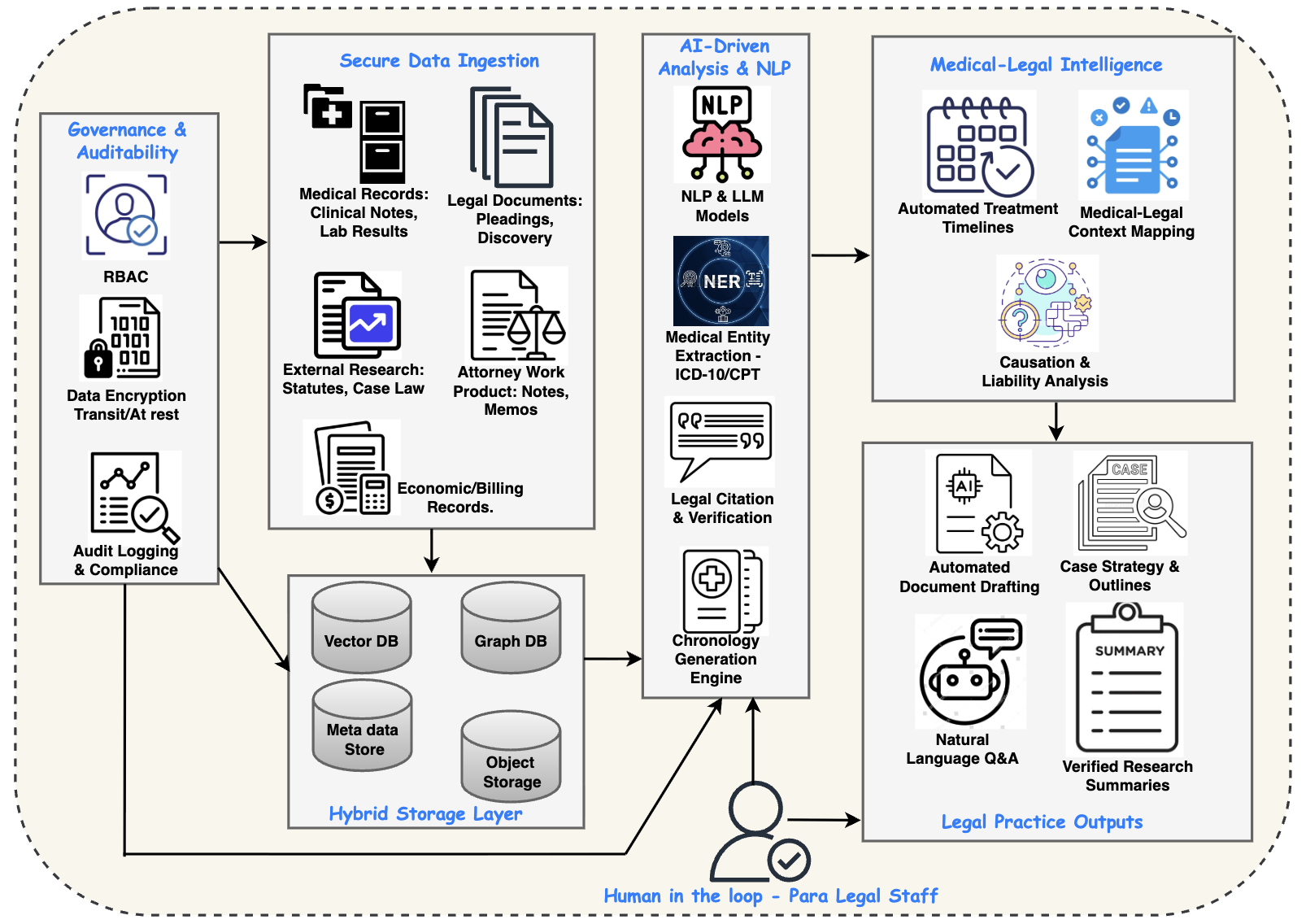
Governance & Auditability (The Foundation)
Security is woven into the architecture via a dedicated governance layer that oversees the entire data lifecycle. This includes:
- Role-Based Access Control (RBAC): Matter-level permissions ensuring only authorized personnel access sensitive files.
- Data Encryption: Military-grade encryption for all data in transit and at rest.
- Audit Logging & Compliance: Full traceability of all AI interactions and document access to meet strict legal and healthcare regulatory standards.
Secure Data Ingestion
The system provides a secure gateway for high-volume data intake. It ingests and classifies a diverse range of sources, including:
- Medical Evidence: Clinical notes, lab results, and itemized medical billing.
- Legal & Liability Documents: Pleadings, discovery, and police/incident reports.
- Financial & Economic Records: Wage reports and tax records for lost earning analysis.
- Knowledge Assets: External legal research, statutes, case law, and internal attorney work product.
Hybrid Storage Layer
To support both rapid search and complex relationship mapping, the platform utilizes a sophisticated multi-database strategy:
- Vector DB: Enables semantic search and high-speed retrieval of contextually relevant information.
- Graph DB: Maps the complex relationships between incidents, medical providers, diagnoses, and legal claims.
- Metadata Store & Object Storage: Maintains structured data logs and securely houses original raw documents.
AI-Driven Analysis & NLP
This layer serves as the engine of the platform, utilizing Natural Language Processing (NLP) and Large Language Models (LLMs) to interpret data:
- Medical Entity Extraction: Automated identification of ICD-10 and CPT codes for diagnostic and billing accuracy.
- Legal Citation & Verification: Grounding all research in authoritative sources with verified citations.
- Chronology Generation Engine: Sequencing disjointed records into a unified, factual timeline.
- Financial Normalization: Converting billing and wage data into structured formats for damages calculation.
Medical-Legal Intelligence
Moving beyond simple extraction, this layer applies reasoning to the facts of the case:
- Automated Treatment Timelines: Creating visual and narrative sequences of medical care.
- Medical-Legal Context Mapping: Connecting clinical findings to specific legal allegations and jurisdictional requirements.
- Causation & Liability Analysis: Identifying the link between incident evidence (e.g., police reports) and resulting medical conditions.
Legal Practice Outputs
The final layer delivers the business value through specialized interfaces:
- Automated Document Drafting: Generating high-quality first drafts of Demand Letters, motions, and expert outlines.
- Case Strategy & Outlines: Providing high-level summaries and strategic roadmaps for litigation.
- Natural Language Q&A: Allowing attorneys to query their case files and receive evidence-backed answers.
- Verified Research Summaries: Delivering concise, cited research on specific legal and medical issues.
Human-in-the-Loop - Para Legal Verification
To ensure the highest standard of accuracy, the architecture integrates a Human-in-the-Loop verification workflow. Paralegal staff and legal professionals review AI-generated chronologies and extracted facts, providing a feedback loop that refines the analysis before it reaches the final output.
Strategic Benefits for Legal Organizations
Significant Time Savings: Manual research, document review, and medical record analysis are reduced from hours to minutes.
Reduced Risk and Errors: Automated chronologies, code extraction, and context-aware analysis reduce missed facts and misinterpretation of medical evidence.
Consistent Work Quality: Standardized outputs ensure uniform analysis across teams and matters.
Knowledge That Persists: Research, chronologies, and drafts remain connected to cases and become reusable assets rather than disappearing when matters close.
Better Client Outcomes: Faster insights, clearer narratives, and stronger preparation improve client confidence and case strategy.
Governance, Security, and Compliance
The platform is designed to meet the strict requirements of legal and healthcare-adjacent work:
- Role-based access and matter-level permissions
- Encryption for data in transit and at rest
- Full audit trails for document access and AI interactions
- Configurable retention and export policies
- Compliance with enterprise security and privacy standards
Client data remains confidential, controlled, and fully governed.
Looking Ahead: From Case Management to Legal Intelligence
This solution represents a shift from managing documents to understanding cases.
By unifying legal research, drafting, medical chronologies, and medical coding analysis into a single intelligent workflow, legal organizations can operate with greater speed, accuracy, and confidence.
Work no longer resets with each new case. Knowledge compounds. Risk decreases. Lawyers spend less time searching and more time thinking.
That is the future of modern legal practice.