

The Latency of Compliance: Why Retail AI's Policy-Production Gap Is Unsustainable
For retailers deploying high-risk AI systems, biometric surveillance, dynamic pricing engines, customer profiling the distinction between having a compliance policy and having a compliant system will become existential.
At DataMills, we've spent the last three years building a legal-tech engine for personal injury claims that processes unstructured medical data into court-ready documentation. The architecture we developed for sovereign VPC deployment, immutable WORM logging, and confidence based intervention layers was designed for a specific high stakes environment. But as we've mapped these technical controls against the AI Act's Annex III requirements, we've recognized something critical: the plumbing is universal.
Retailers are about to face the same audit logic that healthcare and legal tech have been preparing for. The difference is that most are still treating compliance as a documentation exercise rather than an infrastructure problem.
The Consultant Gap in Retail
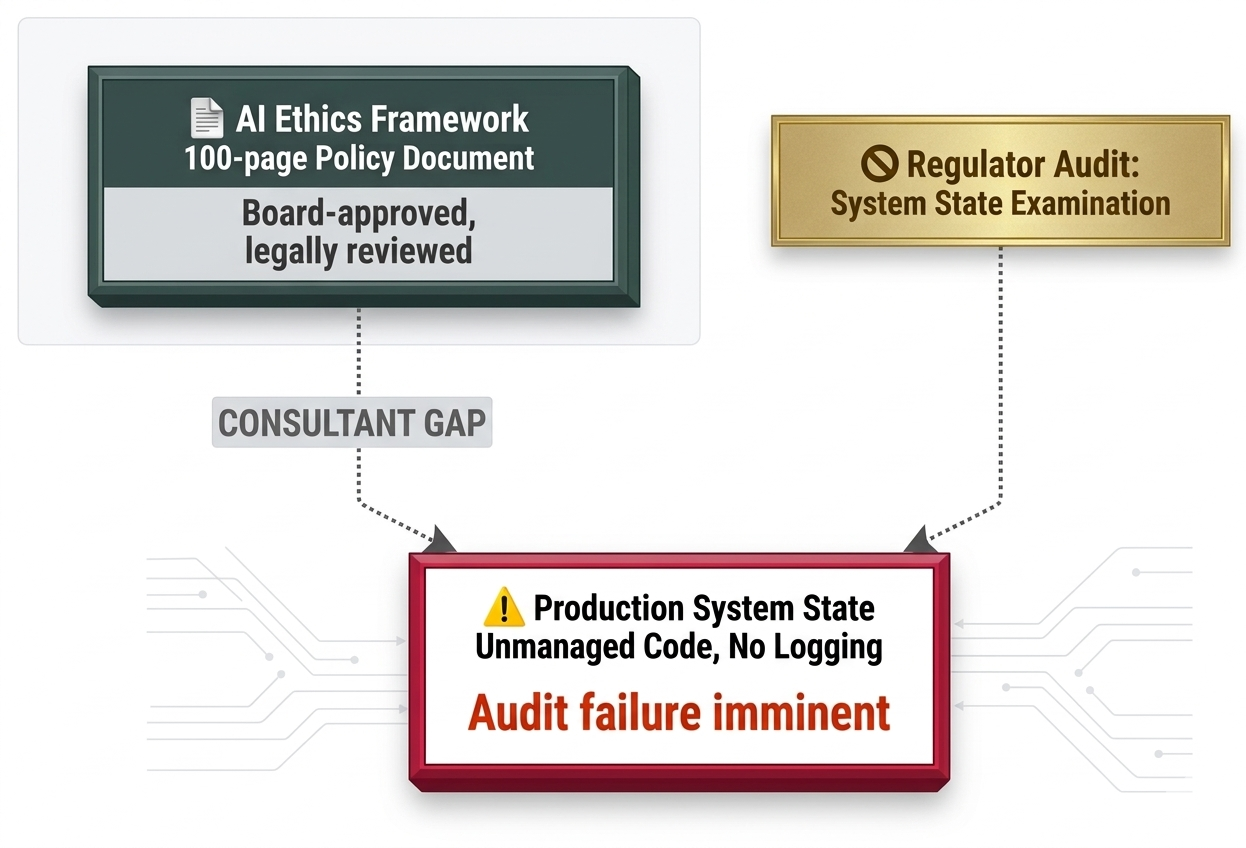
We use the term "consultant gap" to describe a specific failure mode: the disconnect between a firm's documented AI ethics policies and its actual production system states. In retail, this gap is particularly acute.
Consider the typical retail AI stack. Front-end personalization engines process browsing behavior. Backend systems run predictive inventory models. In store computer vision enables loss prevention through facial recognition. Generative AI powers product descriptions and dynamic pricing scripts. Each of these systems intersects with customer data, often in ways that trigger multiple regulatory frameworks GDPR, consumer protection rules, and now the EU AI Act.
The consultant gap manifests when a retailer has invested in a 100-page "Responsible AI" framework but their production code lacks:
- Immutable logging of model decisions (Article 12)
- Explainability APIs that can generate technical nutrition labels on demand (Article 13)
- Human override mechanisms for low-confidence biometric classifications (Article 14)
Regulators don't audit policies. They audit system states. When the competent authority arrives, they won't be impressed by the policy PDF. They'll be examining your API gateways, your vector storage architectures, your CI/CD pipelines for model updates.
High-Risk Triggers in Retail Environments
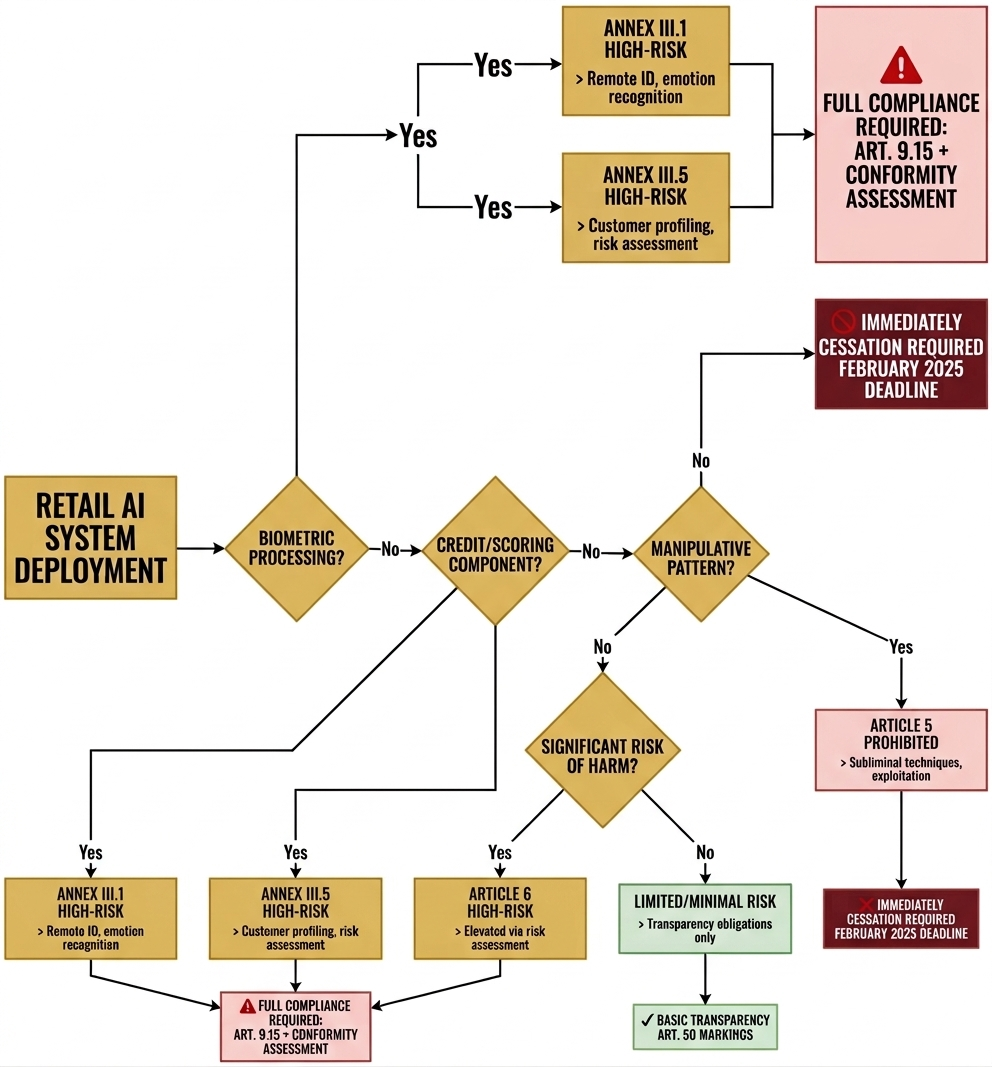
The AI Act's Annex III doesn't contain a category explicitly labeled "retail." This has created a dangerous misconception that retail AI systems are largely outside the high-risk scope. The reality is more nuanced and more hazardous for unprepared deployers.
The following table outlines potential high-risk AI system triggers in retail environments:
Annex III Category | Retail Application Examples | Risk Rationale |
|---|---|---|
Biometric surveillance (Annex III.1) | Facial recognition for shoplifting prevention, gait analysis for customer tracking, emotion recognition for sentiment analysis | High-risk when deployed in publicly accessible spaces; already subject to partial prohibition (Article 5) enforced since February 2025. |
Customer profiling and scoring (Annex III.5) | Loyalty programs that algorithmically score purchase history, personalized pricing, credit scoring for store financing | Becomes high-risk when determining access to essential services or producing legal effects. |
Biometric Surveillance
Biometric surveillance (Annex III.1) is the most obvious trigger. Facial recognition for shoplifting prevention, gait analysis for customer tracking, emotion recognition for sentiment analysis these systems are unequivocally high-risk when deployed in publicly accessible spaces. The prohibition on real-time remote biometric identification in public spaces (Article 5) has been enforceable since February 2025, yet we're still seeing retail deployments that haven't been retrofitted.
Customer Profiling and Scoring
Customer profiling and scoring (Annex III.5) presents a subtler risk. Loyalty programs that algorithmically score purchase history, personalized pricing that adjusts based on inferred vulnerability, credit scoring for store financing these systems become high-risk when they determine access to essential services or produce legal effects. A dynamic pricing engine that infers a customer's financial distress and adjusts prices accordingly isn't just ethically questionable; it may violate Article 5's prohibition on manipulative techniques that distort behavior causing harm.
Article 6 Elevation Risk
The Article 6 elevation risk is perhaps the most insidious. Even systems not explicitly listed in Annex III like standard recommendation algorithms can be classified as high-risk if they pose significant risk of harm to safety, rights, or fundamental freedoms. In retail, where recommendation systems influence purchasing decisions at scale, this "significant risk" threshold is easier to cross than most organizations assume.
Retail AI Systems: Compliance Control Mapping
Retail AI Category | Specific Examples | Annex III Mapping | Critical Compliance Control |
|---|---|---|---|
Biometric Surveillance | Facial recognition for loss prevention; emotion detection for customer sentiment | High-risk (Annex III.1); prohibited if real-time remote ID in public | Article 5 ingress blocks on prohibited feature vectors; Article 14 confidence-based human overrides |
Customer Profiling | Loyalty scoring; personalized pricing nudges; credit-linked assessments | High-risk if credit/essential services (Annex III.5); prohibited manipulation (Art. 5) | Article 13 SHAP explainability labels; WORM forensic snapshots for audit trails |
Dynamic Pricing | Real-time adjustments via demand/location/browser signals | Limited risk unless exploitative; transparency for GenAI elements | Intervention layer for low-confidence decisions; zero-retention LLM pipelines |
Inventory & Fraud | Demand forecasting; payment anomaly detection | Minimal unless safety-critical; high if embedded in regulated products | Article 12 immutable logging; private vector silos per VPC |
Generative Tools | AI product descriptions, virtual try-ons, customer support chatbots | Limited (transparency markings); systemic if scaled GPAI | Article 50 disclosure guardrails; recursive OCR for input validation |
Core Technical Controls for EU AI Act Compliance
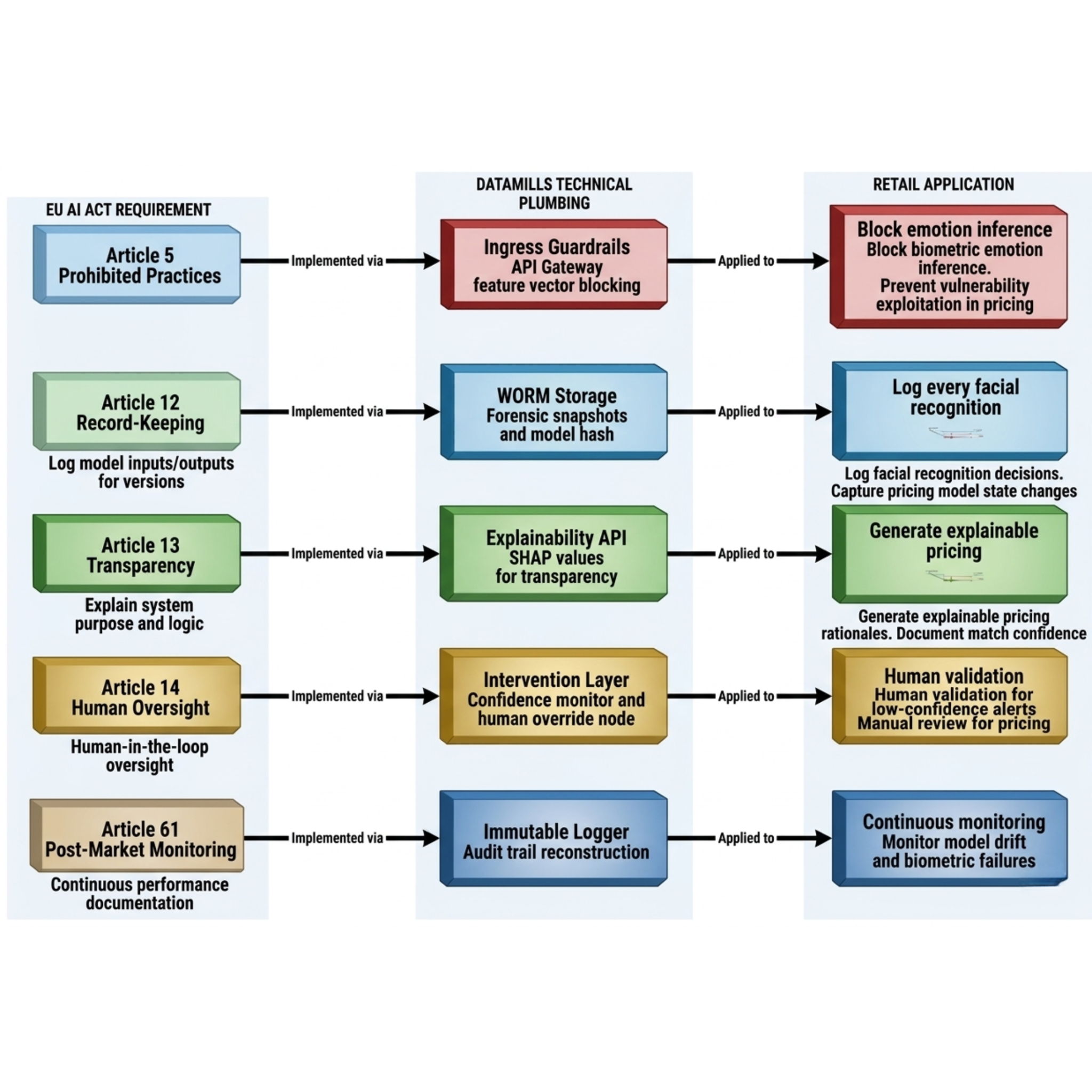
The resulting Sovereign Hybrid Stack is composed of four core technical components whose logic maps directly onto the compliance needs of high-risk retail AI systems under the AI Act.
1. Ingress Guardrails at the API Gateway
In our in-house law software we implement ingress blocks to prevent prohibited feature vectors such as emotion inference or discriminatory classifications from ever reaching the model. For retail, this identical plumbing is essential to:
2. The Intervention Layer with Confidence Monitoring
Our Software’s recursive Optical Character Recognition (OCR) system uses multiple reasoning passes, but when confidence scores drop below a set threshold, the system automatically routes the task to a human override node via a UI ticket. Retail systems require this same architecture:
- Low-confidence facial recognition matches for loss prevention should not default to automated alerts or punitive action; they must queue for human verification (Article 14).
- This mechanism ensures that AI decisions leading to significant outcomes are always subject to human control.
3. Immutable WORM Logging for Forensic Snapshots
Article 12 mandates "technical documentation" that permits the reconstruction of model decisions. We achieve this through Write-Once, Read-Many (WORM) storage, which captures model hashes, input snapshots, and logic paths for every high-risk decision. For retailers, this means:
- Every biometric classification, every pricing adjustment, and every profiling score must be accompanied by a forensic snapshot that can be reconstructed months later during an Article 61 post-market monitoring review.
4. Explainability APIs as Technical Nutrition Labels
Our Law Software generates SHAP values and metadata explanations through an API, allowing legal professionals to query the decision logic without cluttering documentation. Retail systems need equivalent capability:
- When a customer disputes a dynamic pricing decision or a biometric alert leads to a security intervention, the deployer must be able to generate a "technical nutrition label" explaining the AI's logic path on demand (Article 13).
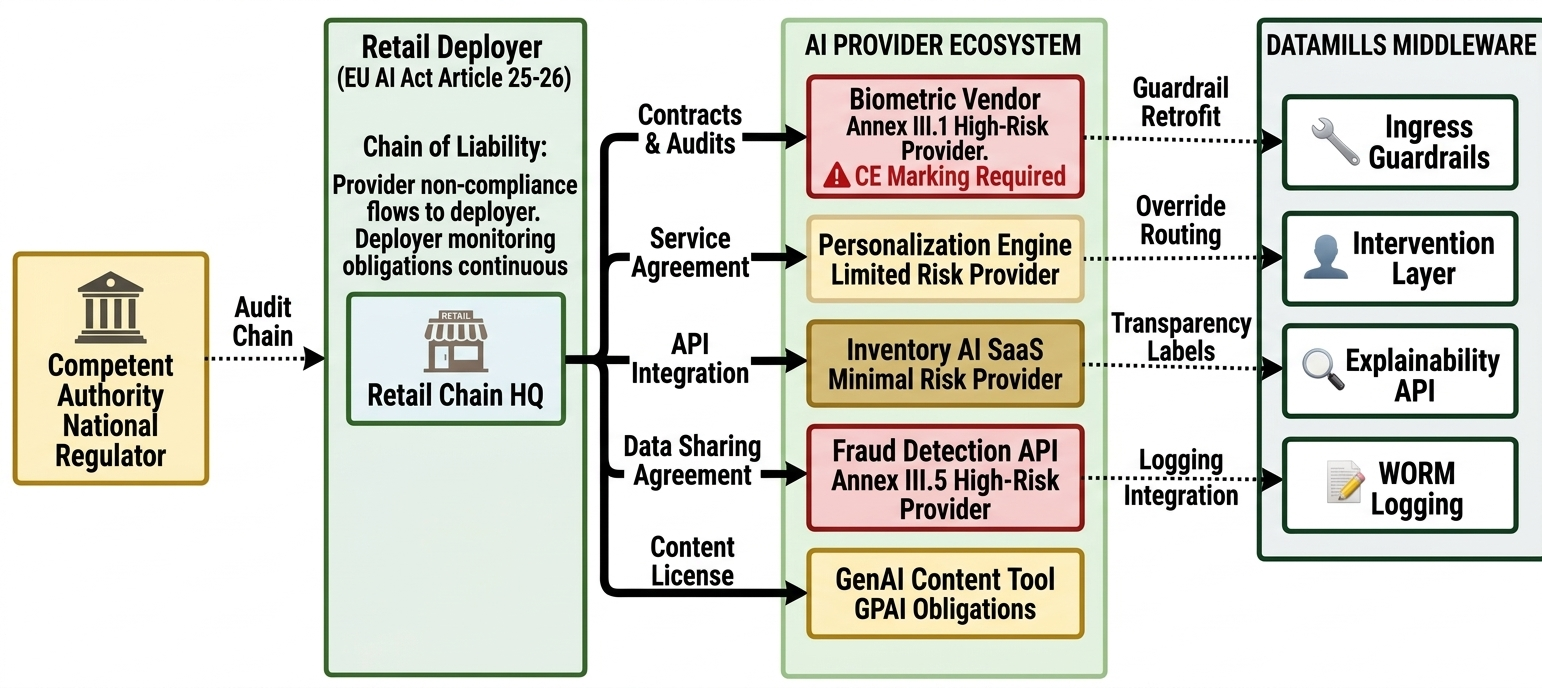
Most retail AI stacks are not monolithic; they are composed of multiple vendors (biometric systems, personalization engines, SaaS fraud detection). The AI Act’s chain of obligations where providers, deployers, and distributors have distinct responsibilities creates complex coordination challenges that cannot be solved with policy documents alone.
Conclusion: From Policies to Plumbing
The AI Act signals a fundamental shift in AI regulation. For high-risk applications prevalent in retail compliance is no longer a matter of governance documents. It is a matter of latency, tech debt, and CI/CD pipelines.
The audit is coming. The question is whether your compliance is in a PDF or in your production code.
DataMills bridges the gap between Law and Code. We build middleware that hard-codes compliance into AI architecture. For technical documentation on our Sovereign Hybrid Stack or to discuss your retail AI compliance roadmap, contact our engineering team.